 EN
EN

Choosing the right LED controller depends on your LED strip type, control method, voltage, installation environment, and smart lighting requirements. For simple home lighting, an RF remote controller may be enough, while commercial and smart home projects often require WiFi, Zigbee, or Bluetooth mesh solutions for flexible control and automation.
A suitable LED strip controller not only determines how users adjust brightness, colors, and lighting effects but also affects system stability, compatibility, and long-term performance. This guide explains how to select the right controller based on practical application needs and helps you find the best solution for residential, commercial, and customized LED lighting projects.
An LED controller is a device that regulates the power output and control signals sent to LED strips, allowing users to adjust brightness, color, and lighting effects. It works as the connection between the LED power supply and the strip light, ensuring accurate control and smooth operation.
For modern LED lighting systems, controllers provide functions such as:
Brightness adjustment (dimming)
Color temperature control (CCT)
RGB/RGBW color changing
Dynamic lighting effects
Remote control operation
Smart home integration
A high-quality controller improves user experience by providing stable signal transmission, precise lighting adjustment, and reliable protection features.
Laimi specializes in developing advanced LED control solutions. Founded in 2019 and headquartered in Bao'an District, Shenzhen, the company focuses on smart lighting products, including RF, WiFi, Zigbee, Bluetooth mesh controllers, TRIAC dimmers, SPI controllers, gateways, smart switches, and intelligent light fixtures. With an independent R&D team, Laimi designs products in-house and provides customized solutions for different lighting applications.
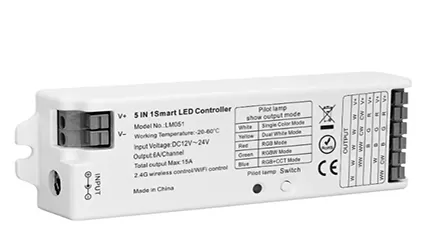
The best LED strip controller should match your LED strip specifications, control preferences, and project requirements. Before purchasing, consider the following key factors:
Different LED strips require different controllers. Choosing an incompatible controller may result in incorrect colors, flickering, or failure to operate.
Common LED strip categories include:
LED Strip Type | Recommended Controller Function |
Single Color LED Strip | ON/OFF control and dimming |
CCT LED Strip | Adjustable warm and cool white tones |
RGB LED Strip | Color changing and brightness control |
RGBW/RGBCCT LED Strip | Independent color and white channel control |
SPI Digital LED Strip | Individual pixel control and advanced effects |
For example, RGB LED strips require RGB controllers, while addressable SPI strips need specialized SPI controllers that can manage individual LEDs.
To explore different solutions, Laimi provides a complete range of LED controllers designed for various LED strip applications.
Voltage compatibility is one of the most important factors when selecting an LED controller.
Most LED strips operate at:
5V
12V
24V
The controller voltage must match the LED strip voltage. In addition, the controller’s maximum output current should be higher than the total power consumption of the connected LED strips.
A simple calculation method:
LED Strip Power (W) = LED Strip Power per Meter × Total Length
For example, if a 24V LED strip consumes 10W per meter and you install 5 meters:
10W × 5m = 50W total power
The selected controller should support at least this power level, preferably with additional safety margin.
Different control technologies provide different levels of convenience and smart functionality. Understanding the available options helps users choose the most suitable solution.
RF (Radio Frequency) controllers are widely used because they offer:
Longer control distance than infrared remotes
No need for direct line-of-sight operation
Simple installation
Cost-effective operation
They are ideal for bedrooms, cabinets, decorative lighting, and small residential projects.
WiFi controllers allow users to manage LED strips through smartphones or smart home platforms.
Advantages include:
Mobile app control
Remote access
Timer scheduling
Voice assistant compatibility
They are suitable for smart homes, hotels, offices, and commercial lighting projects.
For large-scale smart lighting systems, Zigbee and Bluetooth mesh controllers provide stronger networking capabilities.
Benefits include:
Multi-device communication
Stable wireless connections
Smart automation
Integration with smart home ecosystems
These solutions are commonly used in villas, commercial spaces, and intelligent building projects.
A high-performance LED strip controller should offer more than basic ON/OFF functions. The following features can significantly improve lighting flexibility and user experience.
Smooth dimming allows users to adjust lighting levels without flickering or sudden brightness changes. Professional controllers provide accurate PWM dimming technology for comfortable visual experiences.
Depending on your LED strip type, choose a controller that supports:
Single-color dimming
CCT adjustment
RGB color mixing
RGBW and RGBCCT control
Dynamic lighting scenes
Modern lighting projects increasingly require intelligent features, including:
Mobile APP control
Voice control
Scene customization
Scheduling
Group management
These functions make LED lighting easier to operate and more energy efficient.
Reliable controllers should include protection functions such as:
Over-current protection
Over-voltage protection
Short-circuit protection
Over-temperature protection
These features help extend product lifespan and improve system reliability.
Installing an LED controller correctly ensures stable performance and prevents common lighting issues.
Before installation, check:
LED strip voltage
Controller input voltage
Output channels
Total power load
Control method compatibility
The typical connection sequence is:
Power Supply → LED Controller → LED Strip
Ensure that positive and negative terminals are connected correctly.
Depending on the controller type:
RF controllers require remote pairing
WiFi controllers require APP configuration
Zigbee controllers require gateway connection
Bluetooth mesh controllers require network setup
Always test brightness, colors, and functions before fixing the LED strip permanently.
For customized LED lighting projects requiring professional technical support, customers can contact Laimi for suitable controller recommendations.
Selecting the correct LED controller is essential for achieving reliable, flexible, and intelligent LED strip lighting. The ideal choice depends on LED strip type, voltage requirements, control method, installation environment, and desired smart functions.
Whether you need a simple RF controller for residential lighting or an advanced WiFi, Zigbee, or Bluetooth mesh solution for smart projects, choosing a compatible LED strip controller can significantly improve lighting performance and user experience.
With professional R&D capabilities, patented designs, and a wide product range, Laimi provides customized LED control solutions for global customers. For product consultation, technical support, or customized requirements, visit our Contact Us page.
No. LED controllers must match the LED strip’s voltage, channel type, and control protocol. For example, RGB LED strips require RGB controllers, while SPI addressable strips need SPI-compatible controllers.
Yes. Most LED strip controllers require an external power supply to deliver stable voltage and current to the LED strip. The power supply rating should match the total wattage of the LED strip system.
Yes, but the controller’s maximum output power must support the total LED strip load. For larger installations, multiple controllers or signal amplifiers may be required to maintain stable performance.

E-mail:
Phone:
Add:
